Showing posts with label Reminiscing. Show all posts

Friday, November 3, 2023

Fakin' It

 I admit I listened to too much Simon and Garfield back in the 60s and 70s. I think their music is rather introspective and depressing but it seemed right for those those times. 

Remembering those times, I guess I'm feeling rather introspective and depressed.

 ...And I know I’m fakin’ it
I’m not really makin’ it
I’m such a dubious soul
And a walk in the garden
Wears me down
Tangled in the fallen vines
Picking up the punch lines
I’ve just been fakin’ it
Not really makin’ it
No, no, no Is there any danger?
No, no, not really
Just lean on me
Taking time to treat
Your friendly neighbors honesty
I’ve just been fakin’ it, fakin’ it
Not really makin’ it
This feeling of fakin’ it
I still haven’t shaken it ...
I know I’m fakin’ it, fakin’ it
I’m not really makin’ it
This feeling of fakin’ it
I still haven’t shaken it, shaken it ...

Sunday, July 30, 2023

Summertime, summertime, sum sum sumertime.


Just some news from Provincetown, MA

Getting nostalgic for the Cape. 

We will likely be going to California this year as it is 1,000 miles closer and as we will be driving, as vacation time is limited. California is nice, beautiful seacoast but Cape Cod is my happy place.


The National Seashore is a Treasure.  


We always loved hiking the dunes and driving out to the beach oversand with our truck.

This summer has NOT been at all like the summers I used to love. They may be a thing of the past.


Thursday, January 19, 2023

Wednesday, August 17, 2016

In Celebration of Woodstock August 15-17, 1969 - An Excerpt From My Memoir

Soon after my return, [from my junior year in Italy] I got together with a couple of my college friends, Michael Buonanno and Wayne Chesney. Wayne, as I’ve mentioned before, was a bit effeminate despite his tales of womanizing, and Michael, a lanky bookworm-type with dark-rimmed glasses, was a self-proclaimed intellectual and free thinker.

Both were interested in attending (but Michael was the more eager) a concert we’d heard about that was scheduled for later that summer in nearby New York State. I was elected to get us all tickets for the Woodstock Music and Arts Festival, which was to be held from August 15 to 17, 1969.

Since I was the only one of us with a car, I also provided limo services. I picked up Michael in Springfield and Wayne just outside of Albany and we drove down to Bethel, New York, to join a half million or so other young people who were gathering to listen to Jimmy Hendrix, Janis Joplin, the Lovin’ Spoonful, and dozens of other performers who had become icons of the counterculture that was sweeping the country.

We were hearing news reports on the radio about huge traffic backups on the New York Thruway and on rural roads leading to the music venue. Despite the reports about all roads being totally jammed, we decided we would try to get through. About twelve miles from the farm where the Woodstock Festival was taking place, we came to a dead stop. It was Friday afternoon.

Of course we were not the only ones. Cars lined the road and people, these so called hippies mostly, were sitting on lawn chairs or on the hoods of vehicles eating sandwiches, drinking Boone’s Farm, and smoking grass.
.

.
.
Many of the concertgoers began abandoning their Volkswagens, Chevy vans, and beat-up pickup trucks along the side of the road and walking. Some were saying it was a ten-mile walk to the gate, others were saying more like twelve or fifteen.

Michael, not one to think about practical matters or miss out on something he had his mind set on, said, “I think we should walk. Everyone else is.”

Wayne, more cautious and a little out of shape, said, “I don’t know. I suppose if it were a mile or two. But they’re all saying maybe ten miles or more. I don’t think I can walk that far. Besides, that means walking all the way back to our car later.”

“Yeah,” I said, “if we can even find the car again.”

I was quickly coming to the conclusion that we were not the free spirits we pretended to be. “Well,” I said. “I’m not really willing to leave the car here. I’m really not as laid-back as all these freaks and potheads. What if a bunch of these guys on LSD decides my car is a spaceship or something and break in so they can return to the earth from whatever planet they’re on and save the universe?”

I had no clue what tripping might be like, but it was my car, and I had the last word. I convinced them it was prudent to return home.

“Yeah,” Michael said. “I guess you’ve got a point there.”

We dropped off Wayne in his upscale Albany suburb late that evening. Michael and I headed home. It rained hard overnight.

On Saturday evening we heard that the traffic jams around the concert had cleared and the roads leading to the festival were open. Michael and I decided to head back to Woodstock early on Sunday morning. We didn’t call Wayne because it would take too long to drive all the way up to Albany again.
.

.
.
When we passed the gate, or should I say walked over the chain link fence, it was early Sunday afternoon. Most of the concert was over, but groups that had been delayed due to the rain and technical problems were still playing or waiting their turn.

What I remember most is the smell. The aroma of deep, dark, fermenting-hay-and-manure-enriched mud. And alternating whiffs of wood smoke from smoldering campfires and the unmistakable and ubiquitous aroma of cannabis sativa, pot. The combination created a sensory backdrop for the music of The Band, Blood Sweat and Tears, Crosby, Stills ,Nash and Young, and the other groups that played on through the night as we sat on a piece of plastic that we had found left behind in the pile of trash, in the middle of what had recently been a cornfield.

Michael said, “I’ll be right back. I’m going to try to find some grass; I want to get high for this music.” He knew I had never smoked pot and I declined his invitation to try it now, so he didn’t insist I join him. He wandered a few yards away and soon ended up talking to a group of guys and girls. He was laughing his odd, snorty laugh as he took a joint from some guy with long, unkempt hair and a barely discernible yellow bandana that, when he gestured, caught the glow of the campfire in front of him.

Michael took a deep drag and held his breath. “Thanks,” he must have said while trying not to breathe out too much of the potent smoke. Then I’m sure he followed with, “I’ll have another toke, if that’s OK.”

He was not shy about asking complete strangers for something he wanted. He sat down with his new friends until he was sufficiently high to enjoy the music and then wandered back to where I was sitting.

“After the joint, we did a bowl of hash. That’s some good shit,“ he said. “I’m really fucked up.”

We sat, Michael swaying his head to the sounds of Ten Years After. I was probably the only spectator at Woodstock who wasn’t stoned. We sat, me most uncomfortably, on our plastic real estate while others around us were so stoned or high or drunk that they didn’t care about mud or smells or being comfortable.

I was the one who had suggested coming here, but, even though I may have looked like one of the crowd, it was not easy for me to go with the flow. It was never easy for me to go with the flow. I’m not even sure I knew what the phrase meant.

Here I was at Woodstock, in the midst of America’s youth subculture, trying again to fit in. Three months before, I’d been wearing an Italian fitted camicia and hip-hugging black velvet pants at the fancy farewell dinner dance, sipping Sambuca at a trattoria and hailing taxis with feigned European sophistication.

Now, on a smoky August night, I sat with Michael as shirtless hippies made love to their women in the open air on sleeping bags or in sagging orange tents that moved tellingly with their sexual tempo. Rock bands I’d never heard of serenaded all of us into the night.

We’d been mostly awake for more than a day. The sun was rising. It was Monday morning. If I had nodded off at all it was a half-sleep, not dreaming, not fully awake, the music hypnotic except when the microphone squealed every time an announcement was made from the stage; the campfire and marijuana smoke and people walking by, talking, laughing, asking things like, “Hey, man, anybody got some acid?” or “Where are the Porta-Johns?” all wove their way into my sleep/wake dream.

The Porta-Johns, just beyond the field of tents, had evidently been overflowing for days, and entering one was pretty disgusting, even to pee. I was glad that circumstances had shortened the time we had to spend there, the free music not quite making up for lack of creature comforts.

The misty light of sunrise revealed the debris of what had been, for a few days, a small city of half a million people. Empty wine bottles, soda and beer cans, paper bags, blankets, clothing, trampled nylon tents, and smoldering campfires dotted the pasture.

We were too tired to be very hungry. We had eaten the chips and sandwiches we brought along and made a breakfast of some grapes, a package of peanut butter crackers, and a couple of warm Cokes. We wandered around the field taking in the sights—lots of shirtless, barefoot young men caught my eye—as we headed toward the gate.

“You ready to leave?” I asked Michael. “Or do you want to hear more?”

Much of the crowd had already deserted the venue during the night as even hippies had responsibilities that came with Monday morning. Neither Michael nor I had anywhere to be.

“Yeah, I’m ready to go. I hope we can find the car,” Michael said. “I think we came in from over there.” He pointed to the left.

We walked along the side of the road past a wooded area and a pond where people were swimming and washing up. There were a few naked guys and girls splashing around and I envied their freedom. I couldn’t see much from the road, so I also envied their up-close view of the activity.
.

.
.
Buy The Book HERE

Saturday, May 7, 2016

Something for Mothers and.....Too Weird and Too Sad

HAPPY MOTHER'S DAY

Grandma, Maria Concetta [Carlino] DeFrancesco
Grandma, Rosa [Nesta] Daversa
Mom, Theresa [Daversa] DeFrancesco
My paternal grandmother, my gramma, Maria Concetta Carlino DeFrancesco was born in Polistena, near Reggio Calabria in southern Italy. The territory was part of Magna Graecia, in centuries BC, and the name derives from the Greek, Polyxene or Polysthene. But I can’t trace my family much further back than my great-grandparents.

My gramma used to tell stories. Stories of the old country. Apocryphal stories about the saints. Stories with lessons about life and family. But she rarely if ever talked about her childhood or her upbringing or her own family.

I can only piece together a sketch of her life in Calabria from things she hinted at when telling her lessons. She often mentioned the fountain, La Fontana, where the villagers got their drinking water, and maybe only once mentioned the olive groves where they shook ripe olives from the trees onto blankets or burlap tarps and gathered them up for the harvest.

She told about how she used to skin rabbits. After making a slit in the rabbit’s skin and inserting a tube of rigatoni she would blow into the pasta tube to make the air separate the rabbit’s skin from the flesh. And she would peel the skin and fur off the rabbit “like-a you’ pajamas” she would say.

The image of grandma as a young girl peeling the furry pajamas off a rabbit still makes me smile just a bit.

Grandma never talked about her parents. I was never sure why that was.

I remember when she came to our house one Sunday and we were listening to a record album of Italian and Neapolitan songs. One of the songs “Mamma,” seemed to cause her to become a bit emotional - a side of her I’d rarely seen.

It was years before I understood that not only did she leave behind her family in Italy, but that her own mother had died when she was young. Her father had remarried and he and his new wife had more children - two that I know of, Maria Antonietta grandma’s half sister, and Salvatore, a half brother.

Maria Antonietta who we called aunt Zi’Mar’Antone also came to the US. I remember grandma having a kind of rivalry with Zi’Mar’Antone and it was clear she didn’t like or respect her half-sister very much.

I think grandma held some resentment toward the woman who took her mother’s place and bore her half-siblings. But I never really knew that for certain. I did come to realize that the pain of losing her mother was something she bore for her entire lifetime.


For my mother and my grammas:


While working on this post for mother's day and deciding to post a rare photo of my mother with both of my grandmothers, I found myself easily diverted to google maps to find the town of Polistena, Calabria, Italy, the town where my paternal grandmother was born.

There I spotted a street named Via Agrati and immediately thought of Don Agrati (Don Grady) of the TV shows,  Mouseketeers and My Three Sons. He of course was one of the first celebrities I had a teenage crush on while growing up.

As one thing leads to another, I Googled: "What ever happened to Don Grady?" only to learn that he died in 2012.


Why I felt such a profound sense of sadness, I'm not entirely certain. He was only four years older than me, and he died at the age of 68, the age I am now. Yet he is, and always will be, a teenager in my mind and in my libido.

I was reminded about the time, a few years ago, that I looked up a buddy, I hadn't seen in many years, Dennis Silva, for whom I had quite the hots back in my sophomore year of college and about whom I wrote in my memoir - where I called him Silvio DaVilla.

I knew that he was on the faculty of a small college in upstate New York, so, using that information, I  Googled him - only to find, at the top of the page, his obituary. He died in 2012 also.

There again I experienced such a profound sadness that seemed out of all proportion. After all, we never kept in touch, so it wasn't like losing a close friend.

Perhaps it was a different kind of loss. Dennis Silva, Don Agrati, both were men I had had crushes on, been infatuated with or maybe even loved in some way. I don't want these men to be dead; I don't want my fantasy to die along with them.

Perhaps it was realizing that death is unfair, that it comes too soon, that it robs the living when it takes a friend, a love, a fantasy. When it rips a secret out of one's heart.

And though I started with a tribute to two generations of mothers, my mother and my grandmothers, I was brought to a totally different place where I reflect on the ephemeral nature of life and my own mortality.

Friday, July 31, 2015

Those Were The Days (2)

Lately I've been thinking about a song that was popular in 1968, Those Were The Days My Friend by Mary Hopkin. 

It was played over and over on the juke box in the student center at Loyola in Rome, Italy where I spent a lot of time writing letters and poetry, drinking cappuccino and eating cornetti

In this slide show are several photos from my memoir plus many more previously unpublished photos. Some, about which I should probably be embarrassed. 

But isn't that the whole point of nostalgia? To celebrate, not so much the past, but the fact that we were there, where ever that was. That we proudly occupied a space in time and in history.


I hope you enjoy it.

Sunday, October 5, 2014

All That Glittered Was Gold and Rainbows

When I was in college, long, long, ago, I was standing in line at the cafeteria when a rainbow appeared in the field across the street. 

I mean the rainbow was right there, in the field. You could see it's end touching the ground and it was so near you could almost touch it yourself.

Some of us ran like fools, out of the cafeteria, across the road and into the field. The rainbow retreated a little further away with each stride we took. But it was still so close you could almost touch it. Almost.

Of course we never did catch the rainbow nor did we find a pot of gold in the field where it had touched down.

Twenty years or so ago Leon and I saw some gold rings in a shop - I think it was in Portsmouth, New Hampshire or possibly in Provincetown, Massachusetts - I don't remember where we first saw the rings by this particular artist, George Sawyer, because they were available in both locations. 

We both coveted those rings which are very beautiful being made of layered gold which looks like wood grain. 

The gold-smithing technique, after the art of Japanese sword-making, is called Mokume GaneHere are a few examples of George Sawyer's work:

Back then the rings went for around $800 each. Which was more than we could afford. We started saving up though, and when we had saved about $1000, we decided to buy an RV instead. Much more fun and practical.

The next time we had saved some money for our rings the price-tag had gone up to around $1,200. But we put all of our savings toward the house we now live in. Much more sensible and practical.

We pretty much gave up the idea of getting gold mokume gane rings after that, but we still used to "visit" our rings whenever we went to Ptown or Portsmouth. 

Each visit, however, saw the price increase to $1,500, then $1,800 to the current $2,500 - $4,000!

Needless to say, these rings are further out of reach now than when we first saw them. 

Kind of like trying to chase a rainbow. And we still have more pressing and practical needs.
(c) FrankDeFrancesco/End of Trail Productions

Thursday, September 25, 2014

Update - "Did You Ever See A Horse Go By?" - Paperback Edition

Given that the book turned out to be only about 200 pages, I just want to say that I did not set the price for the book - that was set by the publisher. 

I know it may be a little steep for some of you guys (it certainly would be for me). Sorry about that. 

Anyhow the paperback version (there will not be a hard cover edition) is currently available on FastPencil.Com at this URL:


I'm told it will be on Amazon fairly soon. Before long there will be used copies available for twenty-five cents, no doubt.

Anyhow, I am lousy at self-promotion, but if any of you read the book and like it, don't pass it on - tell your friends to buy their own copy!

I haven't even got a copy yet - I think I get 5 copies as a courtesy from the publisher. 

Thanks to all of you for reading this blog and for all your support.

 Thank You! Thank You! Thank You!
- Frank

P.S. THERE WILL BE A BOOK SIGNING AT THE BRISTOL PUBLIC LIBRARY ON OCTOBER 30TH at about 7:00 PM.

More updates to follow.

Wednesday, September 24, 2014

"Did You Ever See A Horse Go By?" - My First Amazon-Kindle Publication

We just got back from P-town after two weeks of fun, sun, surf, sand, and sticker shock, (more on that later) only to finally read and follow-up on some email.

My colleague and a member of Lefora Publishing let me know I now had an ISBN and sent me a link to Amazon.

I'm thrilled to say I'm now available on Amazon in Kindle form.
Now this is both scary and exciting: scary because I'm finally out there in a way that is very different from the blogosphere. Scary because being out there means being open to criticism from a possibly wider audience. People whose opinions may be not so nice. Oh, well! I think I'm ready for it. And exciting - well, because it's pretty damn exciting to be published - and by a publisher who thinks me worthy of print.

From what I can ascertain, the print version of the "book" is not yet available.

But for the Kindle edition, click here: http://www.amazon.com/Did-Ever-Horse-Coming-Memoir-ebook/dp/B00NTCZH7W/ref=sr_1_1?ie=UTF8&qid=1411494101&sr=8-1&keywords=did+you+ever+see+a+horse+go+by

Wednesday, August 13, 2014

(Gay) Camping Ain't What It Used To Be - with additional photos

Our Truck and Camper
Just returning from a five-day stay at Hillside Campground in Pennsylvania where we enjoyed seeing some old friends and joining in with the 25th Anniversary celebration of the Northeast Naturist Society at the campground.

Leon and I used to go to Hillside frequently during its/our heyday – the late 80s and throughout the 90s and even into the 2000s when driving 5 hours seemed like a lark. It’s been five years since we were last there for a camping trip.

Five years is a blink of an eye, but in gay years, it seems like fifty. Five years ago I was already sixty-one, an old man to the eyes of many in our culture, but still feeling like a young fifty. The past few years have been a little rough on me and, as I was to find out, rougher on many others.

Years ago, when we first went to Hillside, when I would still get a flutter of excitement through my body as we drove down the dirt road to the big green wooden gate, it was like going to a new gay country where no straights were to be seen once the gate was shut behind you.

Back then, we slept in the back of a 1983 Ford Econoline Van and thought we were in heaven. What was I, maybe 42, 43 at the time? - Old enough to know better but still largely an adolescent by gay standards, especially considering I was a late bloomer. Everything was exciting, an adventure.

The old Hillside campground, on weekends, used to be packed. There was a waiting list for campsites. The young men and men would stream in on Fridays, the dance hall would be shaking and all manner of goings-on would be taking place in the trailers, tents and woods all weekend.

That doesn’t seem to be true any longer. At least the crowds have dwindled some and the energy is gone. A lot has changed over the years and some of us speculate about what has caused a decline in Hillside’s popularity.

One thing is, there has been a significant amount of competition from other gay campgrounds in Pennsylvania, some with upgraded facilities and nicer amenities.

Another thing is, and I hope it isn’t true, but I’m guessing that most gay young adults are just clueless about anything having to do with the outdoors as most have been holed up in their rooms and connected to the internet since they were in grade school. Camping is not in their repertoire and may even scare some of them. Spiders and froggies and bears, oh my. (Lots of bears. A Sasquash or two. Some abominable.)

I think another factor is that the place has gotten a reputation of being a retirement village.

The campground used to be populated with guys in their thirties and forties, some younger, a few older. Now it seems like there are only old men like me there – as evidenced by a proliferation of poundage, golf carts and even an oxygen tank or two, (although I am still walking and breathing on my own). At Saturday night’s drag show even one of the drag queens was using a walker to exit the stage.

And conversation usually gets onto topics like the benefits of hearing aids, or someone’s last surgery, condition or obituary.

Some of us guys often have little code words to alert our partner or friends to a hot guy in the vicinity. Now I am in no position to make fun. But sometimes I just can’t help it. I’m going to hell, I know.

After seeing the crowd at Hillside I told Leon, “When you see a cute young guy, just say ‘nurse’ and if he’s hot and a little more mature, say ‘doctor’.”

We then got even more cruel and started classifying campers in categories: “residents” for average old guys; “patients” for those who are obviously impaired; “nurses aides” if they’re really young, smooth and fey; “orderlies” if they’re over thirty, have face and body hair, and a bit homely.

I AM GOING TO HELL for this and so much more. But I guess I’d classify myself as a “resident” and on the verge of becoming a “patient” myself. So there.

Yeah, the age thing gets to me.

Over the years, we went from the van to a small camper, then to a larger one, then a big fifth wheel and now we’ve downsized again to a 24-foot tag along, so now it is a challenge preparing meals in a small space, making the bed, getting dressed, doing almost anything in a cramped space that we share with Benni, our 100 pound Weimador.

Doing things now is more of an effort, not just because we have a smaller camper – but just because I’m older. Packing groceries, making sure we have everything we need, hooking up the trailer, setting up camp, cooking, dishes, dumping the holding tanks, having fun. Yeah, having fun is work.

I hate to be trite by saying that having fun is work or to use a cliché, “the thrill is gone”; or the colloquial, “been there, done that.” But perhaps it is time for a transition...And, as much as I fight it, go hiking, mow the lawn, do gardening, build stonewalls, keep active, try to eat a healthy diet, lose a few pounds, I am feeling the age in my bones, in my body, and, worse, in my spirit.

I see age reflected in my own mirror and this past week I’ve seen it reflected, no magnified, in my camping peers as well – even those a few years younger than me and certainly in those as old or older than me – most showing their age even more than I do.

I’m not sure if the past weekend has put things in perspective or out of it.

Things seemed somehow distorted: old guys trying to be boy scouts, talking about ancient conquests (and I don’t mean war stories), moving sluggishly and lugubriously in an environment that used to be so vibrant, so full of activity, so erotic, so full of life. Maybe my glasses were dirty.

Some permanent camps:


Leon and Benni
One of the Younger Fellows


Thursday, July 31, 2014

Update on Sound View Beach, Old Lyme, CT

Took  a ride to the shore yesterday for a beach fix. On the way to the state beach I drove by Sound View to snap a few photos. I never got out of the car, so the photos are a bit blurry or badly composed.

Hartford Avenue is practically deserted. Just the residents and a few day trippers use the beach.
Hartford Avenue
I think it was the town of Old Lyme along with the fuddy-duddy shore-line residents who were tired of the motorcycles, the drunks, the noise that forced out the businesses. Rather than clean things up, I think they just made it more and more difficult to do business there.Those postcards with cars lining the street are a thing of the past. There is no free street parking - spaces are rented at a kiosk and parking lots charge $7.50 to $15 a day for parking - but for what?

The El Morocco - Long Closed and Abandoned 
The Italian Bakery (forgive the blurr)
This Used to be an Arcade
The arcades were very popular with the teenage crowd. Kids played pinball games and skeeball, and ice cream and snacks were sold there.
How Sorry is This
The Carousel is Still Clean and Operating
Lemon Ice - Closed?
This Photo Says It All
The Club - With The Mandatory Imported Palm Tree
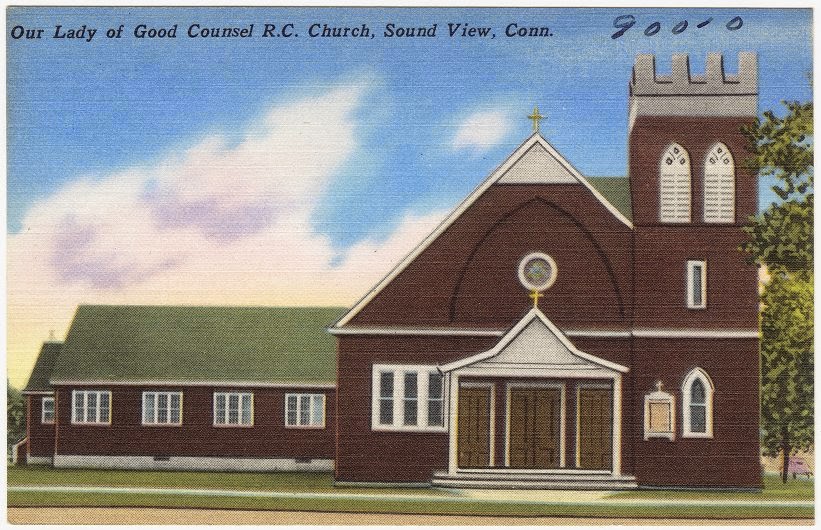
The Catholic Church used to be filled for Sunday Mass thirty years ago. Where have all the Catholics gone?
Even the Catholic Church Sold Out
To Some Generic Variety Christian Family Church

Thursday, July 24, 2014

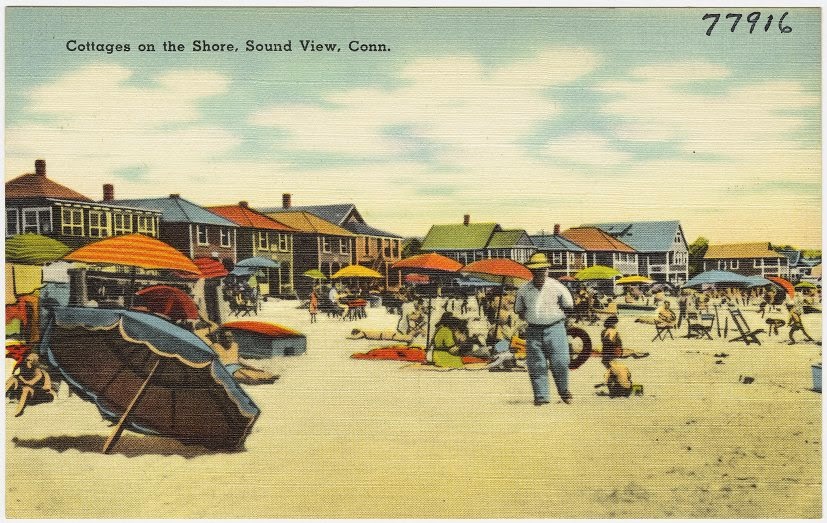
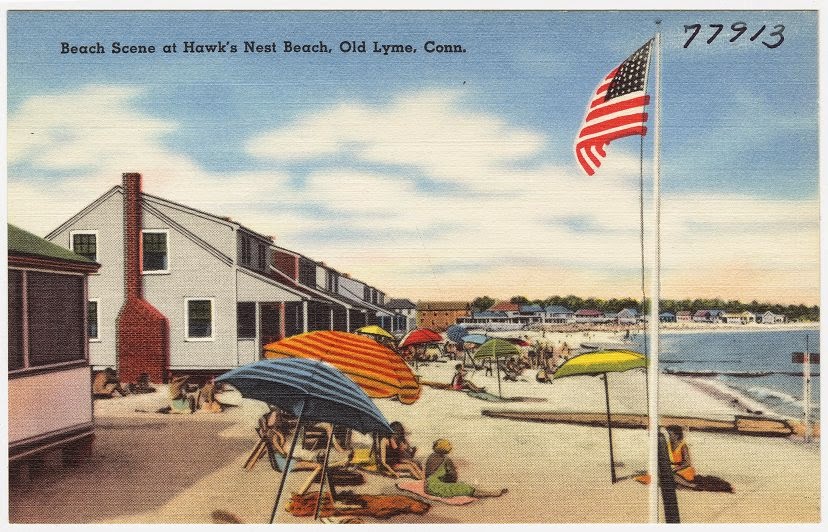
Sound View -- The Way I Remember It

Photos via Digital Commonwealth 
from Boston Public Library, Tichnor Brothers Postcard Collection 
Terms of Use (as appended to each item): 
No known copyright restrictions. No known restrictions on use.
Note: These Postcards are slightly before my time
 A Little Background

Here in Connecticut we have beaches; our shoreline on Long Island Sound is mostly privately owned with only a few state owned public access beaches. 

In Connecticut, a line of state Supreme Court cases dating back to the earliest days of the State confirms that private property generally ends at the mean high water line (the line on the shore established by the average of all high tides) and that the state holds title as trustee to the lands waterward of mean high water, for the use and benefit of the public. … A waterfront owner may not exclude the public from lawful uses of the public trust area, just as an upland owner cannot exclude the public from driving or walking on the street in front of his or her house. (Connecticut Department of Energy and environmental Protection – Connecticut’s Shore – The People’s Resource)

However, getting to that strip of “public beach” can be a challenge. Back in the sixties a community organization out of Hartford held protests to open the shoreline to the public and sometimes “invaded” private beaches to make their point. The problem was and is that no one can get to that public area without trespassing through private property or coming in by boat. Though the protests forced property owners to make some accommodations to the public, most individual property owners and beach associations still found ways to completely restrict access to the shoreline through physical barriers, lack of parking or exorbitant parking fees, resident only restrictions and subtle or overt intimidation.

With that sketchy background, I offer my impressions of being at the beach back when I was growing up. They may not be accurate in a historical sense, but they are my memories of many summers compressed into one composite snapshot, a collage of sorts:
For those of us not fortunate enough to own beachfront property, visits to the beach were limited to either the few state beaches or to private beaches where one might rent a cottage.

No one in our family owned beach property until one of my uncles bought a place in Westbrook. He had a large family of his own, children and grandchildren so the cottage was fully occupied all summer. The rest of us – extended family including my parents, aunts, uncles and cousins – were infrequent guests there.

We did, however often spend a week or more at some cottage we rented at a private beach, a family or two going in together to rent a place or my brother and I being invited guests of an aunt and uncle or cousin. It was usually a different house or beach each year, but Sound View Beach in Old Lyme stands out because we rented cottages there or near there several times.
Once some relatives rented a large house on Swan Avenue at Sound View that accommodated several families. I think there were 15 or 20 of us: cousins and aunts an uncle or two, all on my mother’s side. Most of the uncles stayed home to work, of course.

Private beaches in Connecticut back then more than now, seemed to reflect the demographics of the cities where we grew up and like the various Catholic parishes and Protestant and Jewish communities, the beaches were more or less segregated by ethnicity.

The WASPs, I’m sure, held the properties in places like Greenwich and Madison and Old Saybrook where Katherine Hepburn lived and where we would visit the marina to see, as aunt Mary quipped, “how the other half lived.”
Other ethnic groups had clusters of cottages in various shoreline towns where the more affluent families among them had purchased properties, which they would then rent to relatives and friends for a week or two at a time. The practice ensured that each of these well-established enclaves retained an ethnic characteristic charm or ambiance.

Sound View beach was inhabited primarily by families of Italian descent and because Sound View was one of the few beaches that had a business zone with bars and eating establishments, amusements and sundries, the ethnic flavor was enhanced, primarily by the food being offered for sale at little shops and outdoor restaurants: fried dough and calzones, grinders and gelati, Sicilian pizza, cannoli, pasticciotti and Italian bread at the bakery which was run by an old Italian couple - they were in their eighties for at least twenty years that I knew of. Across the street we would buy fresh doughnuts from the doughnut shop  that was open only on Sunday mornings and you had to get there early, before they ran out.

Sound View was the only beach that I knew of that had this kind of a very, very, little, Little Italy –where there was actually a nightlife and where people strolled down the main street, Hartford Avenue, after dark taking in the night air or trying to find a wayward son at one of the many arcades that line the street.
The El Morocco is the Stone Building
With Yellow Awnings Over Arched Windows on the Left
It also had at least three bars or nightclubs, a sleazy hotel called the Branmore and rumors of call girls. I was fascinated by one of the nightclubs because of its somewhat exotic architecture: a stone and mortar building with arched windows and a big sign “EL MOROCCO” spanning the length of the building. In my young adult years, when it was closed and run down, I thought I should buy it and turn it into a great Italian restaurant. As far as I know, it remains empty to this day as the whole business district is practically a ghost town.

The beach community back then had a seemingly decadent, earthy atmosphere. It also had its own summer "seasonal" Catholic church. Which made perfect sense.
The Sound View beach itself was no more than six or seven hundred feet at most – the little village, about three or four neighborhood blocks wide and maybe a quarter mile in length from the state road to the high water mark. The Sound View village, and I use the term loosely, was flanked by two other beach associations, both of which were entirely residential.
To the west is Miami Beach – a name I always thought pretentious, and the residents there were also mostly Italian-Americans back then. In contrast to their neighbors, they wanted privacy, peace and quiet, and mostly looked down on the more gritty Sound Viewers. The Miami folks frequented the businesses on Hartford Avenue for recreation and commerce nonetheless, while at the same time gating their streets to prevent any deliberate or accidental crossover in the other direction.

Further west was Hawk’s Nest, another private beach association whose residents also came over to Sound View for the amusements and food.
To the East of Sound View was Old Colony beach, a community of cottage owners who were mostly of Jewish ethnicity and who, although they also frequented Sound View for the food and fun, pretty much kept their beach even more private than the Miamians. We almost never strolled down their streets but we did cross over to their beach.

The cottages we rented back then were no palaces. They came with old pots and pans, mismatched dishes and assorted utensils, forks, spoons and knives, lumpy beds, old living room furniture, unusual lamps, a stack of board games for rainy days, a stove, and a broom. There was running water, a bathroom and usually an outdoor shower stall. I think renters had to bring bed sheets and towels.

Our families packed as if for a cross-country caravan: food for a week that included the mandatory meatballs in tomato sauce (no, we NEVER called it “gravy”), towels and clothes, beach blankets and inner tubes, beach umbrellas and coolers. Beer, wine and booze were way down the list, if they even made it at all. Ours was not a drinking family. Ours was an eating family.

I loved being at the beach. There were very few chores and they were shared by so many that even the chores were fun. Washing and drying the dishes, taking out the garbage, hanging towels on the clothesline, sweeping the sand out of the cottage a couple of times a day. There wasn’t much else involved as aunts did all the cooking unless we kids took charge of the outdoor grill. I once witnessed a seagull swoop down and snatch a full chicken leg and thigh off a hot barbeque grill, fly up to the cottage roof and proceed to swallow the whole thing in a gulp.

Despite the beach rules (PROHIBITED: Littering - Alcoholic beverages – Pets - Motorized vehicles - Glass containers - Ball playing - Open fires / grills - Watercraft tied to any buoy line – Fireworks - Loitering - Camping, sleeping on beach after dark - All containers may be subject to inspection - No lifeguard on duty - swim at your own risk - Beach open sunrise to sunset) we managed to have fun. During the day we played in the water, swam, built sand castles, floated in our inner tubes and invented games involving water, seaweed and sand.

After dinner we would “go for a walk down the avenue” to check out the arcades but rarely were we permitted by our elders to actually go inside where the pinball machines clinked and chimed temptingly and where all manner of delinquency was apparently taking place.
We’d go instead to the Carousel – we called it the Merry-Go-Round – and we would ride around until we ran out of money or got tired of it. I was too chicken to reach for the brass ring for fear I’d fall off my horse. We’d end up at Vecchito’s Italian Ice, where the grouchy proprietors begrudgingly sold us lemon ice. We called it lemon ice no matter what flavor: “Can I have a root beer lemon ice, please?”

I found crossing the lines between the beaches interesting. If you were renting a cottage, you were expected to stay on your respective beach: Miami, Sound View or Old Colony – at least that was where your blanket and stuff would be located. There were definite lines of demarcation.

However if you were walking or swimming you could cross the lines with impunity and “visit” the neighboring beach. If you wanted to swim out to The Rock, a large granite attraction for kids between the ages of ten and sixteen, about a hundred feet off shore, it was much easier to go over to Old Colony and swim perpendicular to the shore rather than swim the longer diagonal distance from Sound View.

Miami beach had nothing like The Rock or anything else of much interest, so while we might walk over there once in a while, we would regularly cross over to Old Colony to swim to The Rock.

The contrast was what always struck me. On the Sound View beach, people were sprawled out on blankets, there was sand on the blankets, on the towels, inside kids swim suits. The young women and girls were slathered up with baby oil desperately trying to out darken one another. The kids were wet and kicking sand every which way and everyone was eating something: sandwiches, cookies, chips, fruit, ice cream. Mothers were clad in last year’s one-piece swimsuit, or more likely one purchased the year before or the year before that or when they were still single. They were all talking and wiping melted ice cream from their kids’ mouths while attempting to read some Harlequin romance. Jewelry among the Sound View women consisted of simple gold crosses on delicate chains, tiny engagement rings and generic gold wedding bands.

On Mondays the hairdressers in bikinis and wearing heavy gold chains with Sicilian Cornuti (horns) would occupy a section of sand in front of the Pavilion, a bar. That was back when there were still male hairdressers and even gay men were bold enough to wear bikinis. Other, macho young men in cut-offs who were going in and out of the bar, as well as their girlfriends, were all a bit rough and casual.

A fence and the rope that ran across the sand and out to a buoy in the water marked the boundary between Sound View and Old Colony. The water and the sand were identical but the contrast in the beachgoers on the two pieces of real estate was stark.
On Old Colony beach, women’s skin was several shades lighter than the Italians at Sound View. They wore fashionable, flashy, colorful swimwear, even if the fashions did not flatter their somewhat plump and fleshy bodies. Strings of large pearls or heavy costume jewelry hung around their necks, flashy earrings hung like fishing lures from their earlobes, and gaudy rings adorned more than a few fingers. They sat under large beach umbrellas, in beach chairs, often around a small table, playing rummy or some other card game while their children played neatly along the shore.

The older teenage boys over at Old Colony all looked bored, maybe because their girlfriends were too concerned about their hairdos to actually get wet. The younger kids would tease their brothers and sisters, swim out to the rock and generally behave a bit more like the kids across the border. Crossing over, it seemed to me like a foreign country.

After The Rock, I was always glad to get back to my beach.

The beach makes me happy. It always has.


(See also a short update HERE)

Wednesday, November 13, 2013

Did You Ever See A Horse Go By? A Coming Out Memoir

I've made passing reference to the fact that I've been working on a memoir. 

I belong to a writers' group - a small group of fantastic people who have encouraged me and offered guidance, feedback and sane company. It has been a long project - I actually started thinking about it and did some writing back in 1987.

The manuscript is finally complete except for a final edit by "my publisher" who are actually members of the writers' group. So while the book is as yet unpublished and as I don't have a clue when it might be and as I don't have much else to say, I decided to post the Preface here. 


Did You Ever See A Horse Go By? 
A Coming Out Memoir
Copyright 2013 Frank DeFrancesco

PREFACE
 Peter, to whom the following letter is addressed, died, like too many others I’ve known, of complications of AIDS. I had never finished composing the letter to him in 1987 and so it was never sent. Here, many years later, I’ve added a few thoughts by way of a preface.
1987:   Dear Peter,
            We had talked about writing, about our need to capture in words the experiences and feelings, the joys and foibles of that mysterious process-event we call “coming out.” While I’m not sure the world really needs another “coming out story”, I feel deeply the need to tell it.            
            I write better knowing I am writing for an audience, so I hope you will be both my audience and my critic, as you are close to the experience yourself and of course you are intelligent, sophisticated and articulate. I will appreciate your feedback.
            We are, both of us, owning our true selves as adults rather than as teens or young men; it has brought us on a mid-life adventure to an exotic foreign land filled with marvelous sights and people and things to do and learn and discover. Learning to get around in this new country is at times exciting, joyful and deeply satisfying and at times dangerous, painful, sobering and even sad. I’ve shed more tears for love lost than I would have liked or even imagined.
            What we are experiencing is adolescence. It’s not particularly easy to be a responsible grown up and to be going through adolescence at the same time. But in some respect, I find that my grown-up life of work and service in the health field is less charged with importance than is the challenge of my adolescent life: experiencing reciprocal erotic love for the first time, along with the drama and jealousies and heartbreaks, not to mention the insecurities around being attractive or desirable. But being out is certainly better than the alternatives – remaining terrified of the dark but too afraid to open the closet door, or living a lonely desperate life or, godforbid, suicide.
             Peter, It is now 2013. I am nobody. I am old – or nearly old as life journeys go. My life, in the grand scheme of things, is irrelevant. So why should my story – my experiences beginning more than half a century ago – matter to anyone? Why should I bother to write down these snippets of my life?
            The answer to that last question is: I had to write this account, even if no one ever reads it, because I am compelled to do so in the same way as I was compelled to come out; it’s a matter of survival. Because, if am to live any semblance of an authentic life I must come out unreservedly and often; because coming out is never only an event – it is a continuous process and one that challenges me daily.
            The woman who cuts my hair insists on making small talk and asks about my wife. How do I respond?
            At the auto repair shop, I tell the service tech, “if there’s a problem, call Lee (who is not yet my spouse), my, uh, friend? partner? significant other?”
            Lee and I are holding hands on a deserted beach at sunset as someone approaches in the distance. Do I let go of his hand or not?
            A close relative introduces Lee as my “friend”; do I make some awkward correction and call him my husband even though we are not yet married?
            Am I afraid to offend the likes of all the Ann Bancrofts in the world with constant gay references, “You haven’t spoken one sentence since I got here,” Ma Beckoff indignantly scolded Harvey Fierstein’s Arnold in Torch Song Trilogy, “without the word gay in it.”
            I am challenged daily to come out, again and again and again, because there still exist subtle and pervasive societal and cultural norms that are intended to force us back into our closets; the veiled but insidious beliefs, behaviors, words, and hatred still go largely unchallenged, even as things appear to be changing.
             I am challenged to come out again and again and again, because of the hate and vitriol and rage that seem to have escalated in direct proportion to the numbers of courageous LGBT individuals who refuse to be silent and invisible and in response to our coming ever closer to achieving equal rights.
            I am challenged to come out again and again and again, because too many gay kids still choose suicide as their only option to escape bullying and familial rejection; because some lawmakers still introduce bills that would effectively deny rights and liberty to LGBT folk; because some religions still wave signs declaring that “God hates fags” while others, not so obvious, use more polite and educated language to condemn and vilify us.
            My “coming out” was not only a matter of self-preservation, it was and continues to be, a uniquely liberating, transformational, spiritual and healing life experience. I do believe that “coming out” is the only antidote to the poison of societal oppression that tries to deceive us into believing that the closet is the safest place to be, that the closet will ultimately protect us from the world, from ourselves and from eternal damnation.
            The closet’s false security is ultimately suffocating and fatal to one’s emotional and psychological integrity, if not to one’s physical existence. The closet is built on more or less equal parts fear, guilt and societal and ecclesial condemnation – a formula for what is called internalized homophobia. The closet derives power from that internalized homophobia, from our internal conflicts and fears: the phony conflict between good and evil; the fears of rejection, reprisals, and violence; a mythologized Last Judgment and ungodly wrath.
            Yet we persist in our coming out as if our lives depended on it. Because they do. Coming out is so vital to our integrity that the impulse to acknowledge and be true to ourselves is, in many respects, not unlike our innate survival instinct.
            The fact that there is such an event that we call “coming out” which is virtually universal to the contemporary homosexual experience suggests that this is not an inconsequential phenomenon. Think about that. Coming out has a reality beyond our individual experience. Our experience of “coming out” is both a unique and a shared experience – one that unites us in some fundamental way.           
            Now, although I am “out” I am still in the process of “coming out.” After all, our gayness is mostly invisible to others. Coming out and being out involves being visible – when we look in the mirror and when others see us. Sometimes, to be visible, we have to be “in their face.” Sometimes we need to tell our stories, each of us, story after story, after story, until they “get it.” Because “they” are still trying to define “us”, tell us who they think we are, tell us that we are “objectively disordered” or sinful, or worse.
            Just who are “they” and who do “they” think they are?
            “They” are not only the ignorant and bigoted, but are often otherwise intelligent and sometimes even well meaning individuals. It amazes and frustrates me that our stories – the actual lived experience of gay, lesbian, bisexual or transgender individuals – are so summarily ignored, discounted and dismissed. It baffles me that many vocal and influential individuals persist in holding to and disseminating absurd, erroneous and irrelevant opinions about us. This is unacceptable and should no longer be tolerated; “they” can only make their own positions tenable by repeating questionable scriptures, fabricated “studies”, pseudo-science and outright lies, over and over – and by wholly disregarding us and our voices.
            I can only pose a few questions for others to try to answer: What is it about homosexuality and sexual and gender non-conformity that makes it such a lightening rod? What is it so unique about this issue that religious factions condemn it, regressive governments ban it, entire cultures punish it and ordinary people are moved to hatred and violence by it? Why are millions of dollars spent to fight us and to deny us equal protections under the law? Why do “they” think they know more about our sexuality, or us, than we do?
            More to the point, why do they care? Certainly “they” outnumber “us” and we’ve always been an easy target. Does their inability to save our souls or change us, or to limit our freedom somehow make them inadequate or fearful? What is in it for “them” that they so persist?
            I can’t answer these questions. But they underlie my need to tell my story.
            As for the first question at the beginning of this preface – whether my story or experiences matter to you, the reader, or not – is for you to decide. But I do know that the lives and the lived experience of gay, lesbian, bisexual and transgender individuals are testaments to their truth and perhaps, that is Truth with a capital T; and that their truth will never be silenced. This is my voice, my truth, for what it’s worth.
            For me, the value in telling my story here, beyond being therapeutic, is to preserve a tiny slice of our collective history – to document what it was to be gay in a particular time and place. I want to remember others who were there along with me, creating our lives and defining our sexuality as we went along.
            I had thought of beginning my story like this:
            Perhaps the world does not need another coming out story. But, I suppose it can’t hurt. Coming out at thirty-six has got to be immeasurably better than not coming out at all . . .           
With fondness and love,
Frank      

LinkWithin

Related Posts with Thumbnails