Showing posts with label FAVORITE POSTS. Show all posts

Monday, November 18, 2019

My First Real Blog Post - February 2006

Friday, February 10, 2006

My Grandma

La Nonna

When Grandma said "You don' know-a nuthin' a yet" she usually meant that our young lives lacked a range of experiences that would teach important lessons and that, in time, we would live them and learn them. She would always add, (depending on her age at the time), "And I'm-a eighty years old-a and I don' know-a nuthin' -a yet." She had that Southern Italian accent that made her seem so ancient, so wise, so venerable. When once we questioned why she would say that even she knew nothing, Grandma told us a story that went something like this:

A long time ago in Italy there was an old woman who was dying. She had always been a very beautiful woman from the time she was young even until then in her old age. And because she was a good and devout woman she prayed, thanking God for a good life and good fortune, for her children and grandchildren and great-grandchildren. "Dio mio", she prayed, "I am dying and I am ready to join my husband and the saints in heaven. I thank you for sparing me the awful death of my sister's husband Salvatore, who was crushed by falling stones in the earthquake, or the unthinkable death of Zi' Maria who was burned in the fire so badly that her family could not know her face in the casket. I am thankful to be dying here, my body, old, but still without a blemish. Grazie, Dio." And after a little while she passed peacefully as the priest performed the rites and her family kept vigil.

The old woman's funeral began with a procession from her home to the church. In the hills of Calabria the churches were often built on the highest hill in town and have many stairs leading up to the entrance. And so it happened that while ascending the steep steps to the church, quite near the top, one of the pallbearers tripped and sent the rest of the men off balance as well. The casket was let go and went tumbling down the stone steps, expelling the body of the old woman, whose flesh was torn and whose bones were now broken and twisted from the mishap.

"You see-a," Grandma concluded her fable, "even aft-a you dead-a, you don' know-a nuthin'-a yet," thereby proving her hypothesis beyond further argument.

Was it just an obvious lesson? Even a good old woman can be guilty of hubris. I am reminded each day that at any moment, within the space of seconds, lives can be, and are, regularly altered, changed forever: either by personal folly or by fate, or because of the compulsions of others.

As I write this I reflect on whether it was by folly or fate that events conspired last week that may result in my losing my job. My life could be altered, changed significantly if I lose my job.

I see myself a kind of "post-existentialist" (is there such a thing?) and as having less in common with Satre than with Sophocles: my perceptions have shifted from the sense of being “thrown into a random world” to that of the world (or everyone else’s worlds) “being thrown at me" with an inevitability that defies randomness. Truly, at this moment, despite the double negative, “I don’t know nothing yet”.

My ancestors, more ancient than Grandma, sitting in amphitheaters at Paestum or Agrigentum understood the inevitability of fate as they experienced the pathos and tragedy of Oedipus dramatically portrayed: how the Scheme to thwart his fate as foretold by the oracle puts into motion the very events that lead inevitably to his fate's fulfillment. My folly and my fate may seem insignificant next to men who, like Oedipus, or presidents, wield power: men who are compelled by their own hubris to set events into motion; men who, unlike Oedipus, experience no angst or honesty. Will the gods take notice?

Friday, July 31, 2015

Those Were The Days (2)

Lately I've been thinking about a song that was popular in 1968, Those Were The Days My Friend by Mary Hopkin. 

It was played over and over on the juke box in the student center at Loyola in Rome, Italy where I spent a lot of time writing letters and poetry, drinking cappuccino and eating cornetti

In this slide show are several photos from my memoir plus many more previously unpublished photos. Some, about which I should probably be embarrassed. 

But isn't that the whole point of nostalgia? To celebrate, not so much the past, but the fact that we were there, where ever that was. That we proudly occupied a space in time and in history.


I hope you enjoy it.

Saturday, October 25, 2014

I Do, I Do, We Did – Finally, After Twenty-Six Years!


Frank Joseph DeFrancesco
and

Leon Jay O’Hart, Jr.


A Celebration of Marriage

Saturday, the Twenty- fifth of October

Two Thousand Fourteen


Frank and Leon, those of us gathered here today are honored to witness and celebrate your commitment to each other in marriage.
As our society still strives to overcome its fear and prejudice we here have grown to recognize the validity and beauty of your love and commitment to one another.
May your love continue to grow sure and strong and true in the days and years of your shared life together.

On Saturday, October 25th, 2014 in a simple civil ceremony at our home and in front of a small contingent of family and friends, Leon and I said “I do”  - taking one another as our life-long spouses, “to support, honor and cherish through all the circumstances we may face and to never stop celebrating our love.”

We exchanged rings “as a symbol of our love and commitment to one another and of the values we share together.”

Leon’s mom “gave Leon away” and my sister walked me down the aisle too. Four of our dearest friends who we’ve known for all twenty-six of our years together, Joyce and Robin and Ed and Jeff, were “Our Best Persons”.

Guests included Leon’s brother Marty and sister-in-law Debbie, his two sisters Brenda and Lisa, a nephew, Neil and his wife Mehgan and their daughter Ada. On my side was my sister MaryAnn, my brother Mike and his wife Claire, my niece Andrea and my cousin Rose. My nephew Joe had planned to be there but had to be in San Francisco on business.

The officiant was Justice of the Peace, Michelle, who is also a member of Chimney Crest Writers (the group that guided and encouraged me through writing my memoir). She performed a beautiful civil ceremony for us.

The ceremony included two songs by Jeff Krassner that I posted recently, “Strong for You” and I hear the Angels Sing”;  my niece Andrea sang and played guitar accompaniment to “Make You Feel My Love” by Bob Dylan (a song which she chose for the occasion).


"Make You Feel My Love"

When the rain is blowing in your face,
And the whole world is on your case,
I could offer you a warm embrace
To make you feel my love.

When the evening shadows and the stars appear,
And there is no one there to dry your tears,
I could hold you for a million years
To make you feel my love.

I know you haven't made your mind up yet,
But I will never do you wrong.
I've known it from the moment that we met,
No doubt in my mind where you belong.

I'd go hungry; I'd go black and blue,
And I'd go crawling down the avenue.
No, there's nothing that I wouldn't do
To make you feel my love.

The storms are raging on the rolling sea
And on the highway of regret.
The winds of change are blowing wild and free,
You ain't seen nothing like me yet. 
I could make you happy, make your dreams come true.
Nothing that I wouldn't do.

We ended with “Prince Charming” by Romanovsky and Phillips for a little levity, but at that point no one was listening - everyone was coming up with hugs, kisses and congratulations.


“Prince Charming” Romanovsky and Phillips
 I met you on a rainy day
But the sun’s been out since
And I knew from that moment that you were my prince
Funny how life is always a big surprise
I thought the man of my dreams would have blue eyes 
I thought you’d be taller
I thought you’d be rich
I didn’t think you’d be moody
And at times such a bitch
I thought you’d be brilliant
A real Einstein
But you’d rather watch TV than challenge my mind 
I thought you’d be happy
And never complain
But you’re so neurotic
You make me feel sane

I dreamt about you
Did you dream about me?
You wore shinning armor
And you rescued me
Funny how dreams are not always as they seem
My handsome prince turned out to be more of a queen 
You’re not as romantic
As I hoped you be
You never buy flowers
At least not for me 
I thought you’d be athletic
With muscles for days
‘cause it don’t matter
‘cause I love you the same
But don’t fear my darling
‘cause it’s you I adore
And I know you can’t be blamed
If at times you’re a bore….

After the ceremony and we had a celebratory toasting with appetizers provided by Joyce and Robin and my sister-in-law Claire who also brought the Asti Spumante.

Around three o'clock we all went to Pagliacci’s, a local Italian-American restaurant where we had made reservations for a party. The waitstaff, especially Allison, was super and the food was excellent. They were gracious enough to serve our wedding cake (a remarkably good generic cake from Costco) and no Italian wedding celebration would be complete without cookies to take home, so I made 12 dozen of Aunt Margaret’s festive Italian cookies (mine are not so fancy) and my sister and Claire also made delicious cookies. Claire provided favors for all the guests.

After the reception Leon and I were off to a local hotel for one night of relaxation - can't really call it a honeymoon, now can we? - a well needed night of peace and quiet.

All in all, the day went off without a hitch - no I guess that's not accurate as we got hitched - it went off just about perfectly. 

Now I have been hinting in past posts that a celebration was being planned, about ordering flowers, about it being a perfect occasion with all our immediate family being together in one place, about some “gay” love songs and about our love affair with the gold mokume gane rings. (Note: after much back and forth with jewelry stores, real and virtual, we purchased our Sterling Silver wedding bands at Ruby’s in Provincetown back in September – it just seemed fitting and serendipitous the day we rode our bikes into town and stopped in on a whim and saw rings we both liked at a fraction of the price of gold; we realized that our rings are symbolic, not a financial investment)

It seems that only Russ, over at Blue Truck, Red State had a clue, but I tried my best to throw him off.

Planning the event was fun. Choosing music, finding a nice reasonable restaurant, making invitations, programs and announcements, ordering a centerpiece and a corsage for Leon’s mom. The only thing that was work was house cleaning – like only Leon can do, and I try to do. We joked about registering at Neiman Marcus, and compared our plans to George Clooney’s recent extravaganza.

Now this was what I called a simple wedding, though it was slightly more than that.
In our attempt to keep it simple, we didn’t tell too many people, including relatives. You know at my age, anything can happen and I didn't want to jinx us - I could have had a myocardial infarction and ended up in the hospital and the wedding may have been canceled. Yet we had a few people who we spilled the beans to asking us if they could come. People were so excited for us. But we just couldn’t invite others beyond immediate family. For one thing we can’t afford it and for another, the house just isn’t that big.

So many people have been very excited when they find out: everyone we’ve told has reacted with loads of congrats and something like, “It’s about time.” or “We figured you’d do it sooner or later.”

We also kept talking about how weird it felt to be considering “marriage”. Neither of us had any wildest dreams, let alone dreams of getting married to a male partner. Same gender marriage was not even a concept when we were growing up. It was unthinkable when we were young adults. And it was unheard of back when we first met in 1988.

It still requires mostly unfamiliar mental calisthenics to wrap around the idea of marrying, even after 26 years.

But we see it as a way of protecting what we have built over those years. And I’m not talking about money, because we haven’t much of that. Having heard horror stories of partners being denied visitation or the right to make decisions or the right to even claim their partner’s dead body or make funeral arrangements, we both think marriage will offer some protection.

And there is for me, at least, the fact that it is a “political statement”.  The fact is that legally we can be married; the fact that there are so many still who hate us – hate us no matter what our “legal” status; the fact that I want to be “in their face” with it to some degree. I want to flaunt it. I want to be able to say to someone who refuses to discuss with me an issue about Leon’s health insurance or whatever, “I’m his spouse. I’m legally able to speak to you.”

And I want us to be counted in the up-coming census. I want us to be added to the growing numbers of same-gender couples who are courageously “out” and visible and being role models in one way or another, whose visibility has begun to make our relationships a matter-of-fact reality.

And I want all the Ma Beckoff’s in the world to get off Arnold’s back and to know that Leon’s and my relationship is every bit as real, every bit as authentic, every bit as loving, as hers or as any male/female married couple’s. And that same sex couples who lose a spouse feel loss as deeply, as profoundly and as heart-wrenchingly as they do.

Being pronounced spouses feels kind of like Pinocchio being transformed by the fairy - now we are real.

Photos and more to come.


Thursday, July 24, 2014

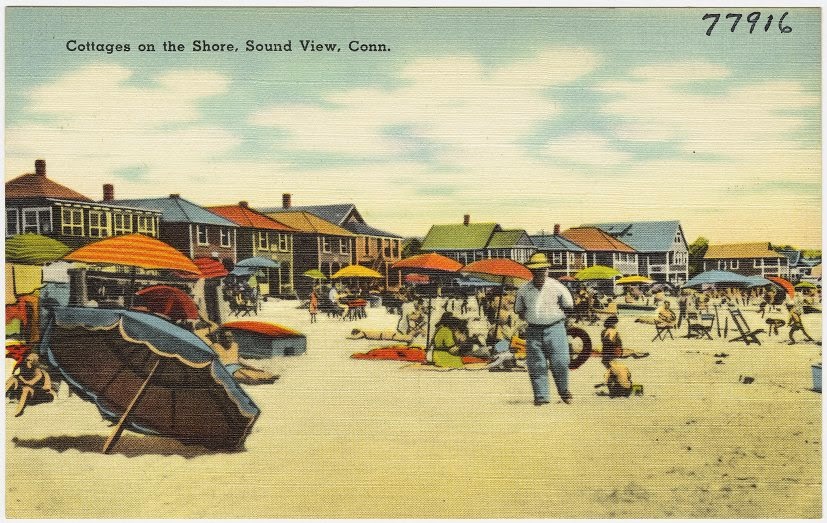
Sound View -- The Way I Remember It

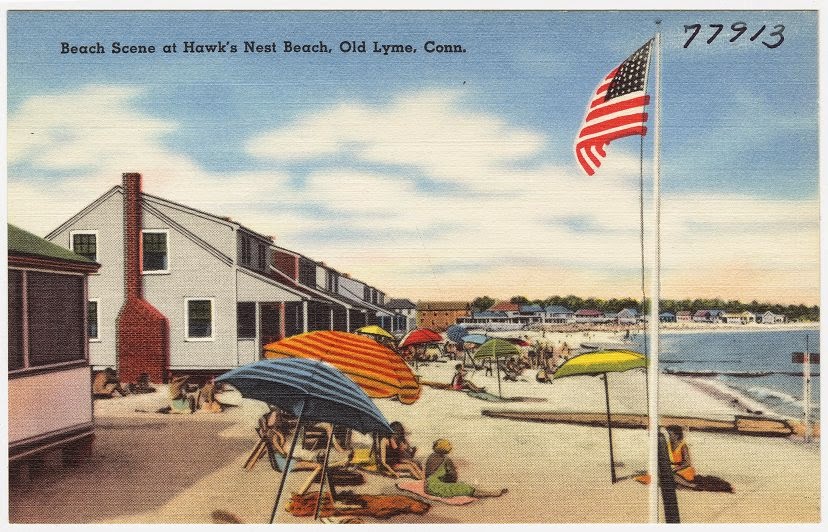
Photos via Digital Commonwealth 
from Boston Public Library, Tichnor Brothers Postcard Collection 
Terms of Use (as appended to each item): 
No known copyright restrictions. No known restrictions on use.
Note: These Postcards are slightly before my time
 A Little Background

Here in Connecticut we have beaches; our shoreline on Long Island Sound is mostly privately owned with only a few state owned public access beaches. 

In Connecticut, a line of state Supreme Court cases dating back to the earliest days of the State confirms that private property generally ends at the mean high water line (the line on the shore established by the average of all high tides) and that the state holds title as trustee to the lands waterward of mean high water, for the use and benefit of the public. … A waterfront owner may not exclude the public from lawful uses of the public trust area, just as an upland owner cannot exclude the public from driving or walking on the street in front of his or her house. (Connecticut Department of Energy and environmental Protection – Connecticut’s Shore – The People’s Resource)

However, getting to that strip of “public beach” can be a challenge. Back in the sixties a community organization out of Hartford held protests to open the shoreline to the public and sometimes “invaded” private beaches to make their point. The problem was and is that no one can get to that public area without trespassing through private property or coming in by boat. Though the protests forced property owners to make some accommodations to the public, most individual property owners and beach associations still found ways to completely restrict access to the shoreline through physical barriers, lack of parking or exorbitant parking fees, resident only restrictions and subtle or overt intimidation.

With that sketchy background, I offer my impressions of being at the beach back when I was growing up. They may not be accurate in a historical sense, but they are my memories of many summers compressed into one composite snapshot, a collage of sorts:
For those of us not fortunate enough to own beachfront property, visits to the beach were limited to either the few state beaches or to private beaches where one might rent a cottage.

No one in our family owned beach property until one of my uncles bought a place in Westbrook. He had a large family of his own, children and grandchildren so the cottage was fully occupied all summer. The rest of us – extended family including my parents, aunts, uncles and cousins – were infrequent guests there.

We did, however often spend a week or more at some cottage we rented at a private beach, a family or two going in together to rent a place or my brother and I being invited guests of an aunt and uncle or cousin. It was usually a different house or beach each year, but Sound View Beach in Old Lyme stands out because we rented cottages there or near there several times.
Once some relatives rented a large house on Swan Avenue at Sound View that accommodated several families. I think there were 15 or 20 of us: cousins and aunts an uncle or two, all on my mother’s side. Most of the uncles stayed home to work, of course.

Private beaches in Connecticut back then more than now, seemed to reflect the demographics of the cities where we grew up and like the various Catholic parishes and Protestant and Jewish communities, the beaches were more or less segregated by ethnicity.

The WASPs, I’m sure, held the properties in places like Greenwich and Madison and Old Saybrook where Katherine Hepburn lived and where we would visit the marina to see, as aunt Mary quipped, “how the other half lived.”
Other ethnic groups had clusters of cottages in various shoreline towns where the more affluent families among them had purchased properties, which they would then rent to relatives and friends for a week or two at a time. The practice ensured that each of these well-established enclaves retained an ethnic characteristic charm or ambiance.

Sound View beach was inhabited primarily by families of Italian descent and because Sound View was one of the few beaches that had a business zone with bars and eating establishments, amusements and sundries, the ethnic flavor was enhanced, primarily by the food being offered for sale at little shops and outdoor restaurants: fried dough and calzones, grinders and gelati, Sicilian pizza, cannoli, pasticciotti and Italian bread at the bakery which was run by an old Italian couple - they were in their eighties for at least twenty years that I knew of. Across the street we would buy fresh doughnuts from the doughnut shop  that was open only on Sunday mornings and you had to get there early, before they ran out.

Sound View was the only beach that I knew of that had this kind of a very, very, little, Little Italy –where there was actually a nightlife and where people strolled down the main street, Hartford Avenue, after dark taking in the night air or trying to find a wayward son at one of the many arcades that line the street.
The El Morocco is the Stone Building
With Yellow Awnings Over Arched Windows on the Left
It also had at least three bars or nightclubs, a sleazy hotel called the Branmore and rumors of call girls. I was fascinated by one of the nightclubs because of its somewhat exotic architecture: a stone and mortar building with arched windows and a big sign “EL MOROCCO” spanning the length of the building. In my young adult years, when it was closed and run down, I thought I should buy it and turn it into a great Italian restaurant. As far as I know, it remains empty to this day as the whole business district is practically a ghost town.

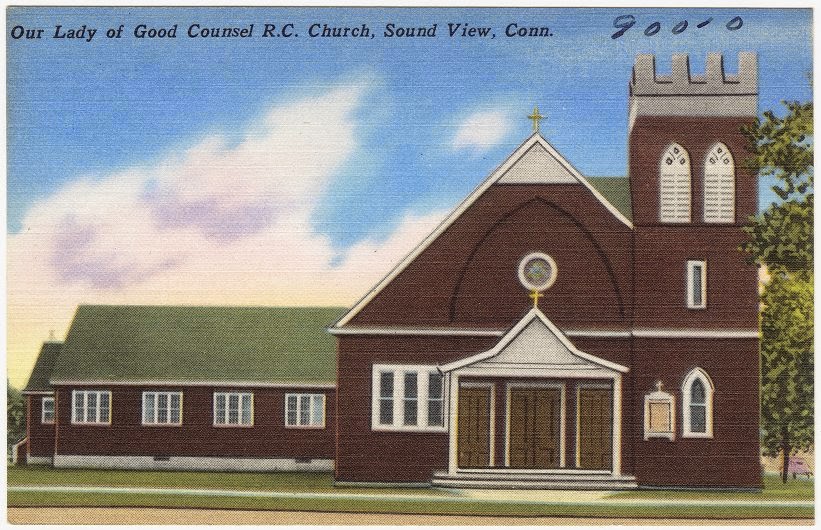
The beach community back then had a seemingly decadent, earthy atmosphere. It also had its own summer "seasonal" Catholic church. Which made perfect sense.
The Sound View beach itself was no more than six or seven hundred feet at most – the little village, about three or four neighborhood blocks wide and maybe a quarter mile in length from the state road to the high water mark. The Sound View village, and I use the term loosely, was flanked by two other beach associations, both of which were entirely residential.
To the west is Miami Beach – a name I always thought pretentious, and the residents there were also mostly Italian-Americans back then. In contrast to their neighbors, they wanted privacy, peace and quiet, and mostly looked down on the more gritty Sound Viewers. The Miami folks frequented the businesses on Hartford Avenue for recreation and commerce nonetheless, while at the same time gating their streets to prevent any deliberate or accidental crossover in the other direction.

Further west was Hawk’s Nest, another private beach association whose residents also came over to Sound View for the amusements and food.
To the East of Sound View was Old Colony beach, a community of cottage owners who were mostly of Jewish ethnicity and who, although they also frequented Sound View for the food and fun, pretty much kept their beach even more private than the Miamians. We almost never strolled down their streets but we did cross over to their beach.

The cottages we rented back then were no palaces. They came with old pots and pans, mismatched dishes and assorted utensils, forks, spoons and knives, lumpy beds, old living room furniture, unusual lamps, a stack of board games for rainy days, a stove, and a broom. There was running water, a bathroom and usually an outdoor shower stall. I think renters had to bring bed sheets and towels.

Our families packed as if for a cross-country caravan: food for a week that included the mandatory meatballs in tomato sauce (no, we NEVER called it “gravy”), towels and clothes, beach blankets and inner tubes, beach umbrellas and coolers. Beer, wine and booze were way down the list, if they even made it at all. Ours was not a drinking family. Ours was an eating family.

I loved being at the beach. There were very few chores and they were shared by so many that even the chores were fun. Washing and drying the dishes, taking out the garbage, hanging towels on the clothesline, sweeping the sand out of the cottage a couple of times a day. There wasn’t much else involved as aunts did all the cooking unless we kids took charge of the outdoor grill. I once witnessed a seagull swoop down and snatch a full chicken leg and thigh off a hot barbeque grill, fly up to the cottage roof and proceed to swallow the whole thing in a gulp.

Despite the beach rules (PROHIBITED: Littering - Alcoholic beverages – Pets - Motorized vehicles - Glass containers - Ball playing - Open fires / grills - Watercraft tied to any buoy line – Fireworks - Loitering - Camping, sleeping on beach after dark - All containers may be subject to inspection - No lifeguard on duty - swim at your own risk - Beach open sunrise to sunset) we managed to have fun. During the day we played in the water, swam, built sand castles, floated in our inner tubes and invented games involving water, seaweed and sand.

After dinner we would “go for a walk down the avenue” to check out the arcades but rarely were we permitted by our elders to actually go inside where the pinball machines clinked and chimed temptingly and where all manner of delinquency was apparently taking place.
We’d go instead to the Carousel – we called it the Merry-Go-Round – and we would ride around until we ran out of money or got tired of it. I was too chicken to reach for the brass ring for fear I’d fall off my horse. We’d end up at Vecchito’s Italian Ice, where the grouchy proprietors begrudgingly sold us lemon ice. We called it lemon ice no matter what flavor: “Can I have a root beer lemon ice, please?”

I found crossing the lines between the beaches interesting. If you were renting a cottage, you were expected to stay on your respective beach: Miami, Sound View or Old Colony – at least that was where your blanket and stuff would be located. There were definite lines of demarcation.

However if you were walking or swimming you could cross the lines with impunity and “visit” the neighboring beach. If you wanted to swim out to The Rock, a large granite attraction for kids between the ages of ten and sixteen, about a hundred feet off shore, it was much easier to go over to Old Colony and swim perpendicular to the shore rather than swim the longer diagonal distance from Sound View.

Miami beach had nothing like The Rock or anything else of much interest, so while we might walk over there once in a while, we would regularly cross over to Old Colony to swim to The Rock.

The contrast was what always struck me. On the Sound View beach, people were sprawled out on blankets, there was sand on the blankets, on the towels, inside kids swim suits. The young women and girls were slathered up with baby oil desperately trying to out darken one another. The kids were wet and kicking sand every which way and everyone was eating something: sandwiches, cookies, chips, fruit, ice cream. Mothers were clad in last year’s one-piece swimsuit, or more likely one purchased the year before or the year before that or when they were still single. They were all talking and wiping melted ice cream from their kids’ mouths while attempting to read some Harlequin romance. Jewelry among the Sound View women consisted of simple gold crosses on delicate chains, tiny engagement rings and generic gold wedding bands.

On Mondays the hairdressers in bikinis and wearing heavy gold chains with Sicilian Cornuti (horns) would occupy a section of sand in front of the Pavilion, a bar. That was back when there were still male hairdressers and even gay men were bold enough to wear bikinis. Other, macho young men in cut-offs who were going in and out of the bar, as well as their girlfriends, were all a bit rough and casual.

A fence and the rope that ran across the sand and out to a buoy in the water marked the boundary between Sound View and Old Colony. The water and the sand were identical but the contrast in the beachgoers on the two pieces of real estate was stark.
On Old Colony beach, women’s skin was several shades lighter than the Italians at Sound View. They wore fashionable, flashy, colorful swimwear, even if the fashions did not flatter their somewhat plump and fleshy bodies. Strings of large pearls or heavy costume jewelry hung around their necks, flashy earrings hung like fishing lures from their earlobes, and gaudy rings adorned more than a few fingers. They sat under large beach umbrellas, in beach chairs, often around a small table, playing rummy or some other card game while their children played neatly along the shore.

The older teenage boys over at Old Colony all looked bored, maybe because their girlfriends were too concerned about their hairdos to actually get wet. The younger kids would tease their brothers and sisters, swim out to the rock and generally behave a bit more like the kids across the border. Crossing over, it seemed to me like a foreign country.

After The Rock, I was always glad to get back to my beach.

The beach makes me happy. It always has.


(See also a short update HERE)

Wednesday, December 25, 2013

Best Friends

Dottie is a good friend that we met a couple of years ago at the dog park in Bristol. Her Czechoslovakian shepherd Katija and our dog Benni hit it off so well they amaze us every time we walk our 2 1/2 miles through the meadow and woods. Which we do usually three or four times each week.

Benni and Katija are truly soul-mates. I have posted several photos and movies of the two romping and running and playing tug with sticks and posing for photo ops on Benni's blog Benedict Bentley.

In early autumn for about a week Dottie was snapping pictures of Katija and Benni every time we went for a walk. I thought nothing of it.

Well, last night we went to Dottie's for dinner and even though we agreed no gifts, Dottie got us a gift. When I unwrapped it I immediately felt a picture frame and thought knew why Dottie had been snapping pictures - that she had one of the photos framed.

But then I saw a familiar signature "N. Poli" and I recognized it as that of Nicoletta Poli, a Provincetown artist whose art, especially her paintings of dogs, we really love.

"No, Dottie, you didn't" I said.

But when I saw the painting, a watercolor of two black dogs in the woods I got all teary-eyed. It was an original painting of Benni and Katija - our two dogs who are truly Best Friends - the title of the painting.

Last summer on a trip to PTown we picked up a book of Poli's prints - all of dogs - and gave it to Dottie as she is a real dog lover. I mentioned that Nicoletta Poli was a favorite artist.

What I didn't know until Dottie told us last night was that she actually made arrangements to meet with Nicoletta to go through the photos she had taken and to commission a work for us. Dottie drove the five hours to PTown to do this, the two women decided on a theme and Nicoletta did the painting and sent it to Dottie a week or so ago. Dottie was so excited to give it to us.

What an amazing person is Dottie! To give such a thoughtful, amazing, personal gift to us. I had tears in my eyes - partly because the gift was so special and partly because Dottie is so special to do this for us.

We are truly blessed to have a friend like Dottie and Benni is fortunate to be Best Friends with Katija.

Benni mentioned the Poli Gallery  once, and again here, but didn't give the name of the artist/gallery.

Here is the link to her gallery: Nicoletta Poli

Christmas Afternoon Madison, CT 12/25/13
UPDATE:

On December 31, 2013 I sent the following email to Nicoletta Poli:

Nicoletta,

On Christmas Eve, my partner, Leon and I were presented with a beautiful Nicoletta Poli painting of our dog Benni and his "Best Friend" Katija, by our dear friend Dottie Kern. 

At first, before unveiling the picture, I thought it might be a framed photo as Dottie had been snapping photographs for weeks, every time we went walking. As I removed the bubble wrap, the first thing I noticed was your signature, which I recognized immediately. I became excited, thinking Dottie had purchased one of your paintings as a gift. 

Unwrapping further - it was a challenge as that bubble wrap was stubborn - I realized that this was not just one of your paintings but a special one of our dog Benni and Dottie's dog Katija. It literally brought tears to my eyes - first, because it was one of your paintings and second, because Dottie had done such a thoughtful, kind and generous gesture of friendship. 

Leon and I were amazed and grateful. Dottie said that because of her initial reaction to the emailed thumbnail photo of the painting, you were a bit anxious about whether we would like the painting. Rest assured that we do in fact love the painting and that it gave us great joy to receive it. 

Thank you for that, and for capturing the essence of "Best Friends".

P.S. We spoke to you last September when we purchased a book of your paintings for Dottie. You checked out Benni's blog. He has written a post about the painting you did of him and his girlfriend. You can read it at:


Thursday, November 14, 2013

On Leaving the Forest - A Love Poem

After I posted the Preface to Did You Ever See A Horse Go By - A Coming Out Memoir, I was thinking about someone who I called Silvio in the book.

He was a guy I went to college with and perhaps the first man I ever had a crush on. I only have one photo of him. Asleep on a sofa in the college library circa 1968.

We spent a lot of time together during the summer after Sophomore year after which I went on to study abroad and Silvio transferred to a state university.

To be perfectly honest, it was more than a crush. I think I was head over heels in love. But, it was 1968 and it was a love that dare not speak its name. At least not in my world.

Silvio and I drifted apart. He got a PhD, married a woman, had a child, and was teaching in a small college in the northeast. He called me once, a couple of dozen years ago to tell me he was visiting his parents in a nearby city and that he would like to stop by for a visit.

I was as nervous as hell, but said "Sure. Love to see you."

Silvio came for a visit and told me his wife had passed away. We talked about stuff, caught up a bit.

Of course I was "out" by then and had been dating Leon. But for one brief moment I entertained a thought that maybe there was a chance my old love might be requited.

We ended our visit without my daring speak the love I'd had for him when we were younger and for some reason we never kept in touch afterwards.

Writing and editing a 300 page memoir brings up a lot of stuff of the emotional sort. So the other day, just for the hell of it, I googled Silvio's real name, PhD and region where he was employed.

The first thing that came up was Silvio's obituary that dated his passing on September 26, 2012. There were no details on the cause of death.

I can't precisely explain the emotions that reading Silvio's obituary stirred up.

A profound sense of sadness.

A sense of loss:
   - of an old friend;
   - of any possibility of renewed contact;
   - of sharing a love that could now speak its name;
   - of a possibility that had remained open-ended, now closed;
   - of youth;
   - of a harbored fantasy;

A sense of my own mortality getting closer - life a commodity in limited supply.

The obit carved out a little space, an emptiness in my soul.

It brought a few tears to my eyes.


On Leaving the Forest - A Love Poem - August 1968 (an excerpt)

I must leave you now forever
for I love you
You are beautiful and dark
and I would love you


Rest in Peace, Silvio, know that I loved you.

Wednesday, November 13, 2013

Did You Ever See A Horse Go By? A Coming Out Memoir

I've made passing reference to the fact that I've been working on a memoir. 

I belong to a writers' group - a small group of fantastic people who have encouraged me and offered guidance, feedback and sane company. It has been a long project - I actually started thinking about it and did some writing back in 1987.

The manuscript is finally complete except for a final edit by "my publisher" who are actually members of the writers' group. So while the book is as yet unpublished and as I don't have a clue when it might be and as I don't have much else to say, I decided to post the Preface here. 


Did You Ever See A Horse Go By? 
A Coming Out Memoir
Copyright 2013 Frank DeFrancesco

PREFACE
 Peter, to whom the following letter is addressed, died, like too many others I’ve known, of complications of AIDS. I had never finished composing the letter to him in 1987 and so it was never sent. Here, many years later, I’ve added a few thoughts by way of a preface.
1987:   Dear Peter,
            We had talked about writing, about our need to capture in words the experiences and feelings, the joys and foibles of that mysterious process-event we call “coming out.” While I’m not sure the world really needs another “coming out story”, I feel deeply the need to tell it.            
            I write better knowing I am writing for an audience, so I hope you will be both my audience and my critic, as you are close to the experience yourself and of course you are intelligent, sophisticated and articulate. I will appreciate your feedback.
            We are, both of us, owning our true selves as adults rather than as teens or young men; it has brought us on a mid-life adventure to an exotic foreign land filled with marvelous sights and people and things to do and learn and discover. Learning to get around in this new country is at times exciting, joyful and deeply satisfying and at times dangerous, painful, sobering and even sad. I’ve shed more tears for love lost than I would have liked or even imagined.
            What we are experiencing is adolescence. It’s not particularly easy to be a responsible grown up and to be going through adolescence at the same time. But in some respect, I find that my grown-up life of work and service in the health field is less charged with importance than is the challenge of my adolescent life: experiencing reciprocal erotic love for the first time, along with the drama and jealousies and heartbreaks, not to mention the insecurities around being attractive or desirable. But being out is certainly better than the alternatives – remaining terrified of the dark but too afraid to open the closet door, or living a lonely desperate life or, godforbid, suicide.
             Peter, It is now 2013. I am nobody. I am old – or nearly old as life journeys go. My life, in the grand scheme of things, is irrelevant. So why should my story – my experiences beginning more than half a century ago – matter to anyone? Why should I bother to write down these snippets of my life?
            The answer to that last question is: I had to write this account, even if no one ever reads it, because I am compelled to do so in the same way as I was compelled to come out; it’s a matter of survival. Because, if am to live any semblance of an authentic life I must come out unreservedly and often; because coming out is never only an event – it is a continuous process and one that challenges me daily.
            The woman who cuts my hair insists on making small talk and asks about my wife. How do I respond?
            At the auto repair shop, I tell the service tech, “if there’s a problem, call Lee (who is not yet my spouse), my, uh, friend? partner? significant other?”
            Lee and I are holding hands on a deserted beach at sunset as someone approaches in the distance. Do I let go of his hand or not?
            A close relative introduces Lee as my “friend”; do I make some awkward correction and call him my husband even though we are not yet married?
            Am I afraid to offend the likes of all the Ann Bancrofts in the world with constant gay references, “You haven’t spoken one sentence since I got here,” Ma Beckoff indignantly scolded Harvey Fierstein’s Arnold in Torch Song Trilogy, “without the word gay in it.”
            I am challenged daily to come out, again and again and again, because there still exist subtle and pervasive societal and cultural norms that are intended to force us back into our closets; the veiled but insidious beliefs, behaviors, words, and hatred still go largely unchallenged, even as things appear to be changing.
             I am challenged to come out again and again and again, because of the hate and vitriol and rage that seem to have escalated in direct proportion to the numbers of courageous LGBT individuals who refuse to be silent and invisible and in response to our coming ever closer to achieving equal rights.
            I am challenged to come out again and again and again, because too many gay kids still choose suicide as their only option to escape bullying and familial rejection; because some lawmakers still introduce bills that would effectively deny rights and liberty to LGBT folk; because some religions still wave signs declaring that “God hates fags” while others, not so obvious, use more polite and educated language to condemn and vilify us.
            My “coming out” was not only a matter of self-preservation, it was and continues to be, a uniquely liberating, transformational, spiritual and healing life experience. I do believe that “coming out” is the only antidote to the poison of societal oppression that tries to deceive us into believing that the closet is the safest place to be, that the closet will ultimately protect us from the world, from ourselves and from eternal damnation.
            The closet’s false security is ultimately suffocating and fatal to one’s emotional and psychological integrity, if not to one’s physical existence. The closet is built on more or less equal parts fear, guilt and societal and ecclesial condemnation – a formula for what is called internalized homophobia. The closet derives power from that internalized homophobia, from our internal conflicts and fears: the phony conflict between good and evil; the fears of rejection, reprisals, and violence; a mythologized Last Judgment and ungodly wrath.
            Yet we persist in our coming out as if our lives depended on it. Because they do. Coming out is so vital to our integrity that the impulse to acknowledge and be true to ourselves is, in many respects, not unlike our innate survival instinct.
            The fact that there is such an event that we call “coming out” which is virtually universal to the contemporary homosexual experience suggests that this is not an inconsequential phenomenon. Think about that. Coming out has a reality beyond our individual experience. Our experience of “coming out” is both a unique and a shared experience – one that unites us in some fundamental way.           
            Now, although I am “out” I am still in the process of “coming out.” After all, our gayness is mostly invisible to others. Coming out and being out involves being visible – when we look in the mirror and when others see us. Sometimes, to be visible, we have to be “in their face.” Sometimes we need to tell our stories, each of us, story after story, after story, until they “get it.” Because “they” are still trying to define “us”, tell us who they think we are, tell us that we are “objectively disordered” or sinful, or worse.
            Just who are “they” and who do “they” think they are?
            “They” are not only the ignorant and bigoted, but are often otherwise intelligent and sometimes even well meaning individuals. It amazes and frustrates me that our stories – the actual lived experience of gay, lesbian, bisexual or transgender individuals – are so summarily ignored, discounted and dismissed. It baffles me that many vocal and influential individuals persist in holding to and disseminating absurd, erroneous and irrelevant opinions about us. This is unacceptable and should no longer be tolerated; “they” can only make their own positions tenable by repeating questionable scriptures, fabricated “studies”, pseudo-science and outright lies, over and over – and by wholly disregarding us and our voices.
            I can only pose a few questions for others to try to answer: What is it about homosexuality and sexual and gender non-conformity that makes it such a lightening rod? What is it so unique about this issue that religious factions condemn it, regressive governments ban it, entire cultures punish it and ordinary people are moved to hatred and violence by it? Why are millions of dollars spent to fight us and to deny us equal protections under the law? Why do “they” think they know more about our sexuality, or us, than we do?
            More to the point, why do they care? Certainly “they” outnumber “us” and we’ve always been an easy target. Does their inability to save our souls or change us, or to limit our freedom somehow make them inadequate or fearful? What is in it for “them” that they so persist?
            I can’t answer these questions. But they underlie my need to tell my story.
            As for the first question at the beginning of this preface – whether my story or experiences matter to you, the reader, or not – is for you to decide. But I do know that the lives and the lived experience of gay, lesbian, bisexual and transgender individuals are testaments to their truth and perhaps, that is Truth with a capital T; and that their truth will never be silenced. This is my voice, my truth, for what it’s worth.
            For me, the value in telling my story here, beyond being therapeutic, is to preserve a tiny slice of our collective history – to document what it was to be gay in a particular time and place. I want to remember others who were there along with me, creating our lives and defining our sexuality as we went along.
            I had thought of beginning my story like this:
            Perhaps the world does not need another coming out story. But, I suppose it can’t hurt. Coming out at thirty-six has got to be immeasurably better than not coming out at all . . .           
With fondness and love,
Frank      

LinkWithin

Related Posts with Thumbnails